
Many business owners link corporate tax (IRC) to profit: no profit, no tax. That is not quite the case. One part of IRC, autonomous taxation (tributação autónoma), applies to certain company expenses and is due even when the year closes with a loss.
What autonomous taxation is
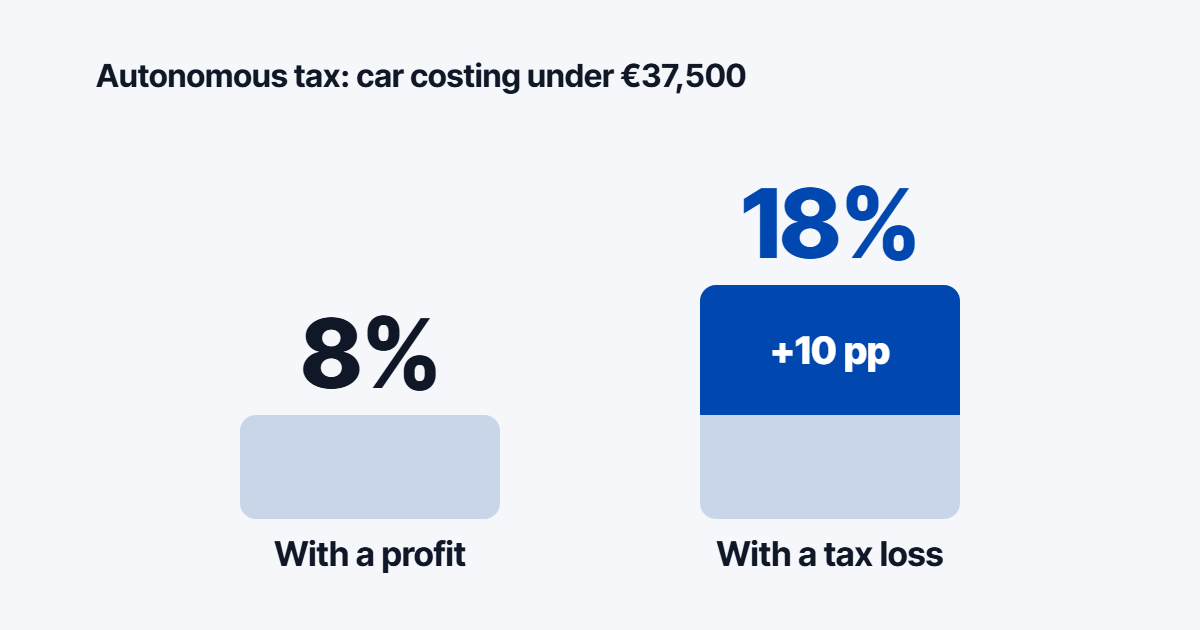
It is a set of rates applied directly to some expenses, such as the costs of company passenger cars (depreciation, fuel, insurance, maintenance, tolls), entertainment expenses and per diem allowances not charged to customers. For a car that cost less than €37,500, the rate is 8%. More expensive cars carry higher rates, and plug-in hybrids and electric cars have their own rates.
The effect of a tax loss
When a company reports a tax loss, these rates rise by 10 percentage points. A simple example: a company with a €30,000 car and €10,000 of annual running costs pays €800 of autonomous taxation in a profitable year. In a year with a tax loss, the amount rises to €1,800.
The exception planned for 2027
Portugal’s 2027 State Budget proposal, approved in principle by Parliament on 28 October and still under discussion, keeps an exception to this increase, as is already the case in 2026. The exception is not automatic: it depends on the company’s history, including results from previous years and filing tax returns on time. Companies starting their activity have their own rules.
Estimating the year’s result before 31 December helps you see whether the increase may apply and plan in good time. Keeping your tax returns up to date also matters.
Guiding these decisions throughout the year is part of our work with every client. Talk to us or book an exploratory meeting.
Sources: Portuguese Corporate Income Tax Code (CIRC), art. 88; Law no. 73-A/2025 of 30 December (2026 State Budget), art. 95(5); Draft Law no. 110/XVII/2 (2027 State Budget).